Introduction to Snowplow Identities
Snowplow Identities provides real-time identity resolution. It stitches together user identifiers to create a unified view of each user, and adds a unified snowplow_id to each event.
Identities allows you to:
- Attribute anonymous events to authenticated users, both within the same session and across sessions and devices
- Connect behavior across web, iOS, and Android apps, when users authenticate with the same credentials on different platforms
- Build on cross-navigation tracking to identify users across domains
- Distinguish between separate users sharing the same device
Use the provided Identities data models to build identifier mapping tables. These tables help with key use cases such as marketing attribution, conversion funnel analysis, multi-touchpoint reporting, audience targeting, feature engineering, and personalization.
Identities is available on Cloud, and on AWS and GCP via Private Managed Cloud. Azure isn't supported.
How Identities fits into the Snowplow pipeline
Identity resolution happens in real time as part of the event enrichment process.
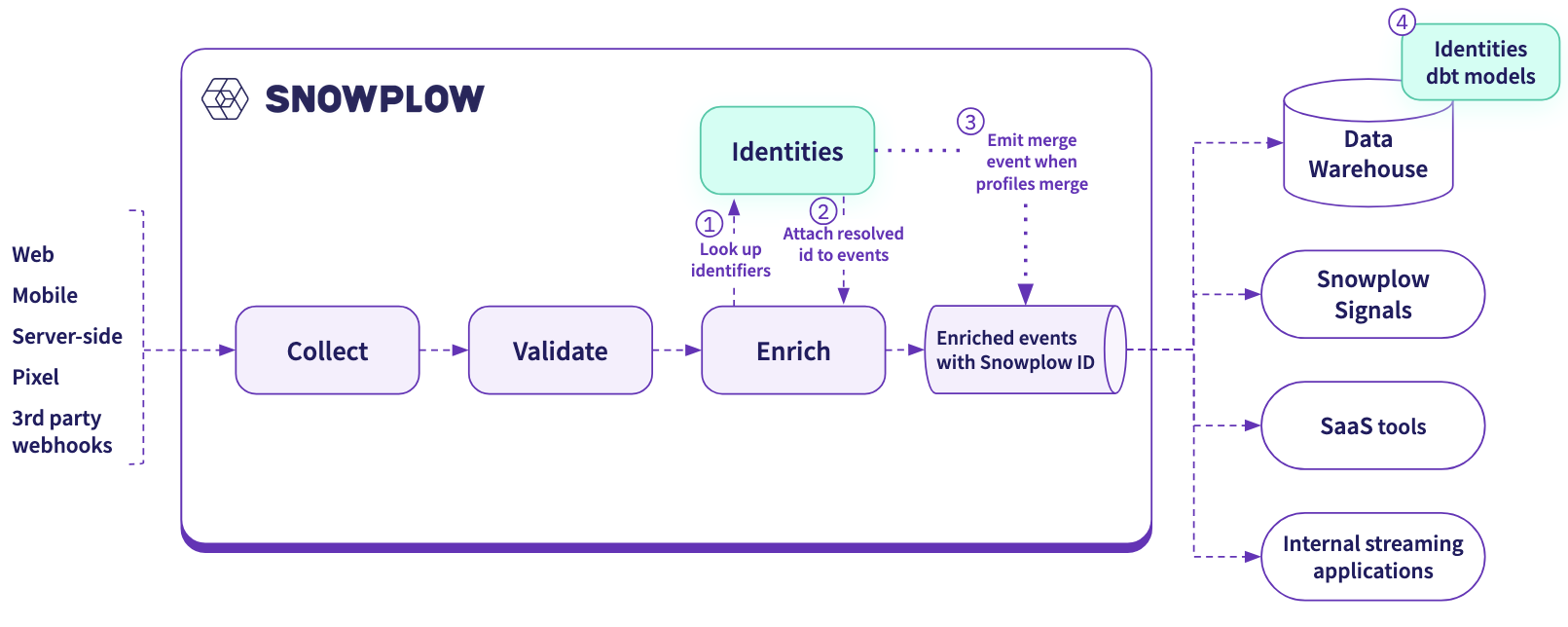
After all other configured enrichments run, the pipeline sends user identifiers in the event payload to the Identities service. It either links the identifiers to an existing Snowplow ID, or creates a new one. Enrich then adds the resolved Snowplow ID to the event in an identity entity.
Some incoming identifiers will reveal that two previously separate Snowplow IDs actually belong to the same user. Identities will merge them in its graph database, and emit a merge event directly into your enriched event stream.
Your Identities infrastructure is deployed into the same cloud as your pipeline. The core components are:
- Identities API: used for identity operations
- Managed Postgres database: persists the identity graph and performs graph operations. Snowplow uses Aurora on AWS and AlloyDB on GCP.
Get started with Identities
Identities is self-serviceable from Console within its supported scale.
To use Identities, start by deciding which user identifiers are most relevant to your use cases. Identities supports standard Snowplow identifiers such as user_id and domain_userid, as well as custom identifiers derived from any field in the event payload. Because your choice of identifiers affects both resolution quality and cost, follow the guidance in choosing identifiers before you configure them.
After configuring Identities, set up the Identities dbt package to create your identity tables.
Fulfill GDPR erasure requests
Identities exposes an API to remove a user's entries from the identity graph. See Erasure for what it does and how to call it.